by Eric James
Revisted August 2019 by Martin Blick
Background
Bowesfield is upstream of Stockton and the parts attractive to birds consist of the areas of low-lying land within two loops of the River Tees.
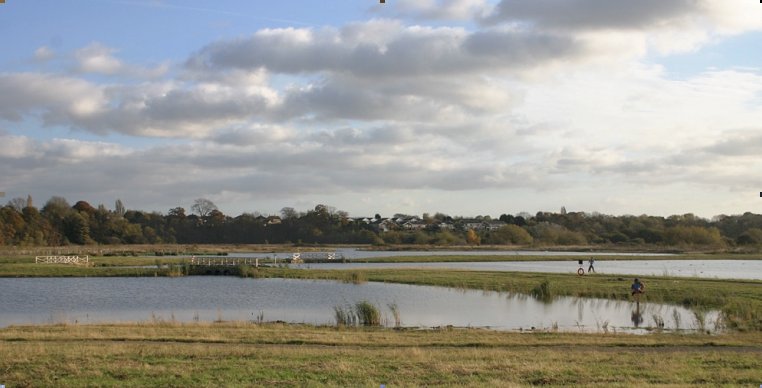
The section in the loop closer to Stockton was used for growing crops until 1994. After this, the ground became excessively wet because of the permanently high water level maintained by the Tees Barrage. It is now being transformed into a nature reserve, while the higher land away from the river has been used for housing and a business park. The work involved in creating the reserve has included the digging of a series of scrapes and pools of different depths and the planting of reeds and appropriate species of shrubs and trees. A mowing regime on part of the grassland is intended to create a meadow-like structure. The reserve is run by the Tees Valley Wildlife Trust (TVWT), who have erected interpretation boards.
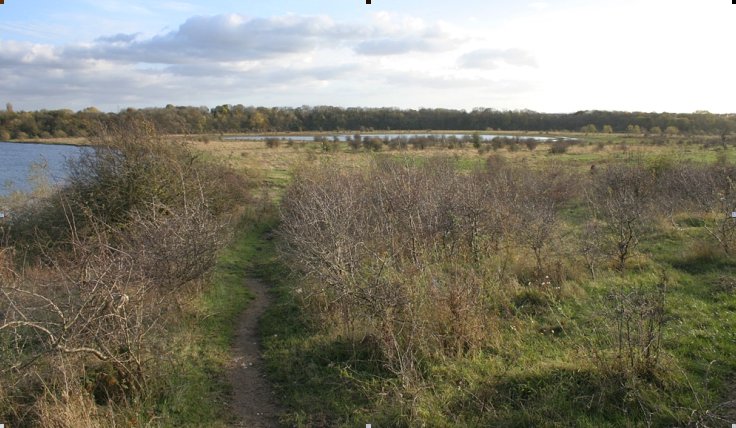
The marsh area in the next loop of the river has not been deliberately developed and looks more natural. There is a large central pool and the surrounding vegetation is a mixture of cropped grass, herbaceous plants and scattered bushes and trees.
Access
Access is from the main Stockton to Ingleby Barwick road, which runs along the west side of Bowesfield. If coming from Stockton, turn left at the second roundabout; from Ingleby Barwick, this is the one after the bridge over the river. It is also possible to approach from the A135 along Concorde Way, which runs through the Preston Park Industrial Estate. The road down to the reserve turns left at the Archers Law building and (at the time of writing) ends there. Parking is available on rough ground on the right. There will be a proper car park here eventually.
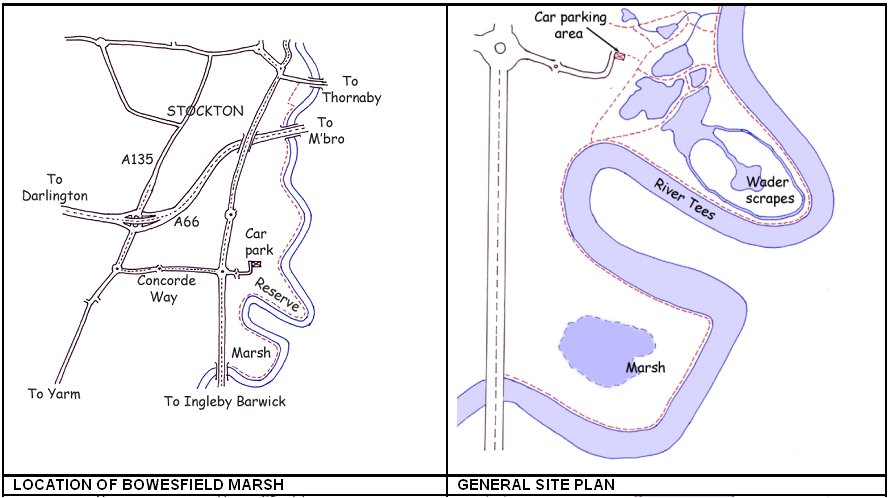
If you’re more energetic, you can walk along the riverside path from Stockton. There is also a walkway/cycle track on the west side of the road from Stockton and this leads to the south end of the Bowesfield area.
Access to the TVWT reserve is easy, as there are tracks around the pools. The scrape can be more difficult to observe when the vegetation grows but it is possible to see it from sections of the path along the river. Following this path upstream takes you to the marsh. You can approach the pool for good views of the water and any muddy edges, though you might have to find a place where you’re not looking into the sun. Don’t try to get too close – the birds can be flighty!
Birds
The marsh can attract reasonable numbers of Ruff and Black-tailed Godwit and there are several records, in the appropriate seasons, of Little Ringed Plover and Jack Snipe. Common Snipe on one occasion reached 110 birds. Passage waders are represented by stints (including Temminck’s), Curlew Sandpiper (with a recent peak of 9 juveniles), Pectoral Sandpiper, the usual ‘shanks’ and Green and Wood Sandpipers. There’s also the odd Turnstone and Avocet.
The deeper water of the new pools attracts diving ducks, while the marsh is good for the dabblers, principally Wigeon, Teal and Shoveler. Pintail are reported most years and Garganey are becoming more frequent. Geese have not used the site much until recently, when flocks of up to 500 Canada and 1000 Greylag Geese have roosted. Swan sightings include Whoopers, as well as the usual Mutes. Rails have included Water Rail, as well as their terrestrial relative, Corncrake. The less usual gull species include Little, Yellow-legged and Glaucous.
Raptors have not been reported very often but Marsh Harrier has been seen and Long-eared Owl has over-wintered once. As the new reserve is providing habitat for dragonflies, then Hobby might be a possibility.
The typical passerines are wetland species, such as wagtails (mostly Pied, but Yellow and Grey been seen) and Grasshopper, Sedge and Reed Warblers. Blackcap and Whitethroat nest here, and Garden Warbler, Lesser Whitethroat and Cetti’s Warbler are seen and heard in some years.
More unusual species seen include Great Grey Shrike, Waxwing, Ring Ouzel, Green Woodpecker, Snow Goose, Glossy Ibis, Mandarin, Bittern, Scaup, Osprey and Green-winged Teal.