by Geoff Myers
Background
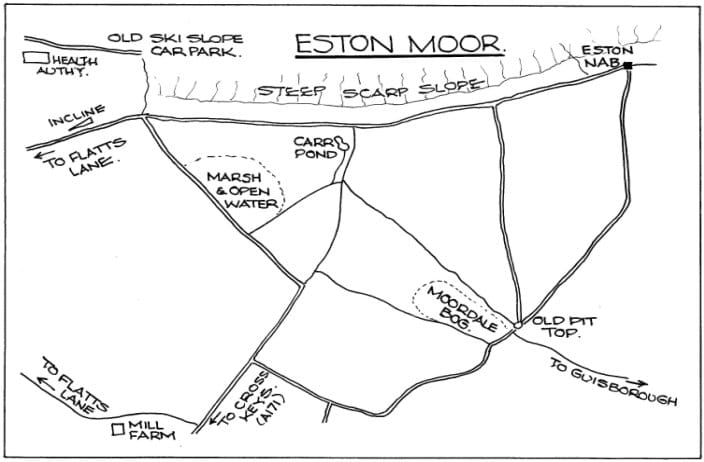
The area generally referred to as Flatts Lane, Normanby, extends along the northern slope of Eston Hills from Ormesby in the west through Flatts Lane to Eston in the east, and on to the higher land of Eston Moor.

Deciduous woodland spreads from Ormesby to just beyond the road at Flatts Lane. This woodland is interspersed with areas of scrub, sadly diminishing due to the growth of hawthorn thickets and the planting of trees. Beyond this area to the east, the steeply sloping hill is bracken covered. Eston Moor was originally heathland but this is disappearing under birch, gorse and bracken since management ceased several years ago as part of local authority financial cuts.
Much of the land belongs to Redcar and Cleveland District Council with the remainder privately owned. A network of public footpaths and bridleways affords good access to all areas. The Council have a Visitor Centre in Flatts Lane on the site of the old Normanby Brickworks. With the help of volunteers, staff here carry out conservation work to most of the woodland and scrub to the west of Flatts Lane. They entertain school parties and other groups thereby introducing children to the countryside. Throughout the site are signs of the industrial past; ironstone mining on the hills and brickworks at both Normanby and Ormesby. Some of the paths follow the old railway lines which served these industries.
Being close to the urban environment there is some vandalism in the area, mainly the starting of fires. Sadly for the birds this is predominantly in the nesting season but a spin off is that it helps to keep an open aspect to some of the scrubby areas. The proposed large housing development nearby will exacerbate this problem.
Access
The best point of access is the Visitor Centre at Flatts Lane where there is a car park. The Centre is well signposted as ‘Flatts Lane Woodland Country Park’. Reach it when travelling from the south by leaving the A171 Guisborough dual carriageway between the Cross Keys and Swanns Corner. The entrance is on the left as you go down the hill. Approaching from the north leave the A66 at Normanby Road traffic lights (near Asda) and travel south, crossing the A1085 road at Eston Baths and the B1360 road at Normanby shops, until you are out of the town and reach woodland on the right. The entrance is on the right as you climb the hill. There is no access to Flatts Lane from the A174 Parkway.

Birds
Local people occasionally create feeding stations throughout the site attracting good numbers of birds including Nuthatch, Jay, Great Spotted Woodpecker, Marsh Tit, Willow Tit and flocks of Chaffinch, Goldfinch and Siskin. Bullfinches are common throughout the site and can generally be heard calling if not seen.
At the first sign of spring, early March, Long-tailed Tits can be seen nest building. The song of Chiffchaff marks the arrival of the first warblers and it is for these birds that Flatts Lane excels. All the common warblers of woodland and scrub can be seen and heard; good numbers of Chiffchaff, seemingly diminishing numbers of Willow warbler, many Whitethroats and Blackcaps and occasional Garden Warblers. The sight of Lesser Whitethroat singing amongst Blackthorn blossom in spring sunshine is a pleasure to see. Wood Warbler is occasionally heard when passing through in the spring.
One of the specialities of the site is Grasshopper Warbler although their usual habitat has now been ploughed up in preparation for a large house building programme. There are however still small isolated areas where they can be heard.
A typical sound of the spring is the Jay, seen in small parties calling excitedly. Drumming Great Spotted Woodpeckers are another accompaniment to any springtime visit although the yaffle of Green Woodpecker is now rarely heard. This latter bird is more likely to be encountered as you climb the hills towards Eston Moor.
During any springtime visit listen for Willow Tit. This is probably the best site in the area for this now very rare bird.

It is quite a climb to Eston Moor but well worth the effort. One word of warning here, Flatts Lane is a narrow and winding road with lots of traffic and care is required when crossing, particularly from the top left of the Visitor Centre field where you need to walk along the road for some 150 yard before crossing.
As you climb towards the moor there are panoramic views over the conurbation and the estuary. Watch and listen for Tree Pipit which, although no longer common, can sometimes be seen displaying.
On reaching the escarpment, as the view behind you disappears so does the noise of the traffic and you could be anywhere on the North Yorkshire Moors. Large areas of birch and gorse and the disappearance of heather makes the sight and sound of wading birds less common than a few years ago but there are boggy areas still suitable for Snipe.
Autumn brings in the winter thrushes. The wooded areas of Flatts Lane have large hawthorn thickets providing rich feeding for these birds, which in those years when they put down immediately on reaching land, can be seen in large flocks.
As winter approaches there is another reason to visit, a Magpie roost. This may not sound attractive to many people but to watch these birds fly in from all directions at dusk and see 100+ sitting in the tops of hawthorn and blackthorn bushes is quite a spectacle. The roost moves around the site but is usually not difficult to locate.
Not many rarities are reported; I saw an adult male Hen Harrier and Red-backed Shrike a few years ago and Golden Oriole was well watched a several years earlier.
Flatts Lane is a bird rich area and well worthy of a visit in any season.
July 2019